Circle of Fourths for Guitar
See the connections between chords and keys at a glance
The Circle of Fourths arranges notes so that each clockwise step rises by a perfect fourth. It is a practical map for finding related chords, pairing major keys with relative minors, and seeing a transposition more clearly.
Open Circle of FourthsHow to read the Circle of Fourths
The purple inner ring shows major chords. The brown outer ring shows the relative minor for each major key: C Major and A minor share a place, F Major and D minor share the next, and so on. Clockwise from the top, the pairs are C with Am, F with Dm, B♭ with Gm, E♭ with Cm, A♭ with Fm, D♭ with B♭m, G♭ with E♭m, B with A♭m, E with D♭m, A with G♭m, D with Bm, and G with Em.
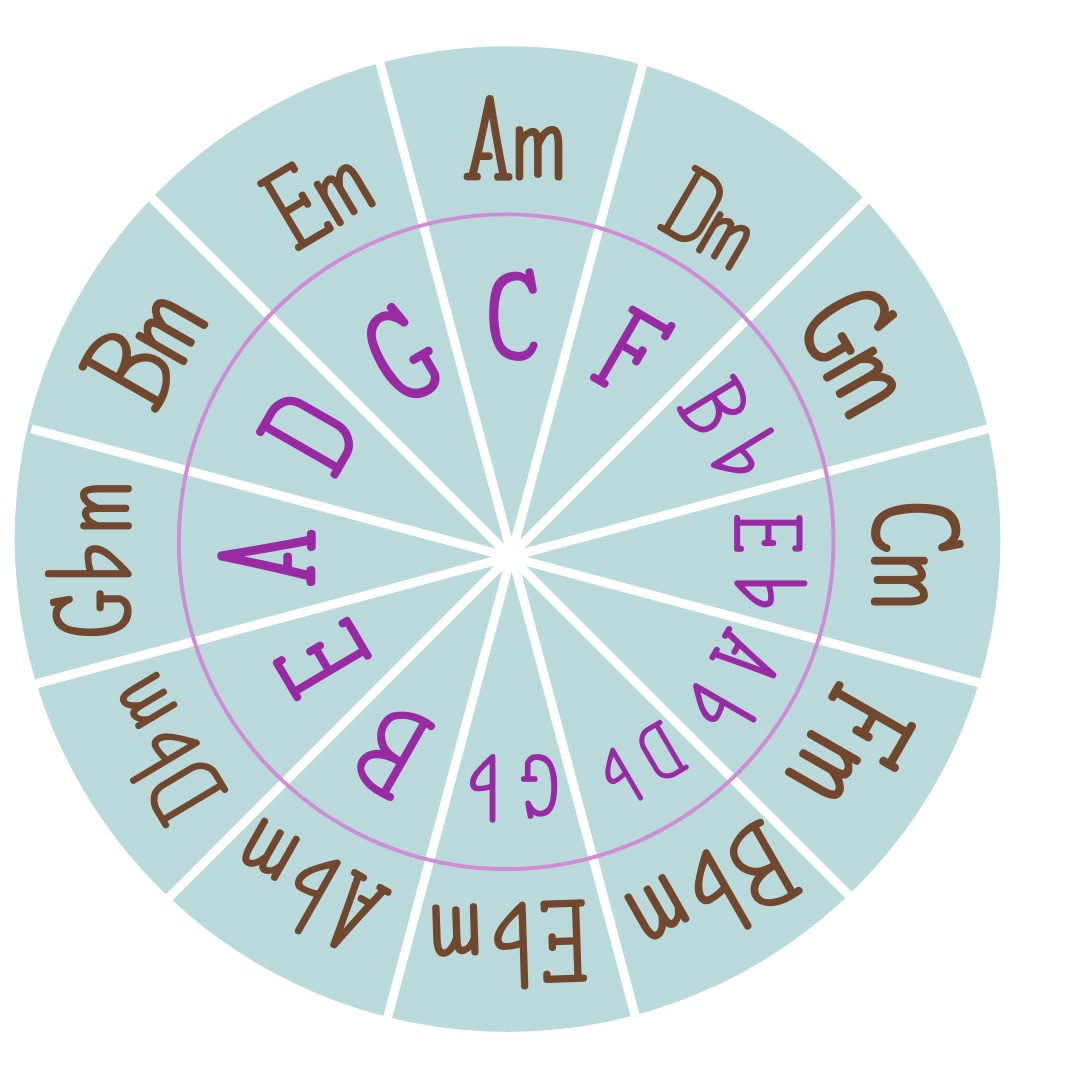
Three relationships to know first
- Neighboring positions
- C is followed by F, and F by B♭. Each clockwise step is a perfect fourth upward. Neighboring keys share many notes, so they are closely related.
- Inside and outside
- Pairs such as C Major with A minor and F Major with D minor are relative keys. They share a key signature, but their musical home—or tonic—is different.
- Direction of reading
- Read clockwise and you move by fourths. Read counterclockwise and you move by fifths. The Circle of Fourths and Circle of Fifths are the same arrangement read in opposite directions.
Use it to find guitar chord progressions
Start by locating the key of your song, then try the chords around it. In C Major, nearby chords include F, G, A minor, and D minor. That makes familiar progressions such as C–Am–F–G and Dm–G–C easy to spot.
- Put the home key at the top
Drag the app wheel until the major and minor pair you want is at the top: C Major with A minor, G Major with E minor, or another pair.
- Use nearby chords as starting points
Look to either side and to the relative minor. For C Major, Am, Dm, F, and G are useful first choices.
- Listen and choose the shape
The circle suggests options; your ear makes the final choice. Use the Chord Chart to find a playable guitar voicing for each chord.
A movement such as Dm–G–C can also be described as resolving downward by fifth. The label matters less than hearing how the neighboring chords lead into one another.
Use it when you transpose
To move a progression to another key, keep the same distances between its chords. For example, C–Am–F–G raised by a whole step becomes D–Bm–G–A. You move every chord by the same amount.
Rotating the wheel is a display aid: it places the key you are studying at the top. It does not automatically transpose a song or change guitar fingerings. Check each final chord shape in the chord chart.
Flat and sharp spellings
The wheel starts with flat spellings because B♭, E♭, and A♭ are easy to follow in this direction. You can switch to sharp spellings in the app. D♭ and C♯, for example, are enharmonic: they sound at the same pitch, as do A♭m and G♯m.
Some spellings on a compact wheel favor readability over the most formal spelling for every key. When writing a chart or communicating with other musicians, choose the spelling that fits the song’s key and notation.
Frequently asked questions
What is the difference between the Circle of Fourths and Circle of Fifths?
They contain the same notes in the same circle. Clockwise reading gives fourths; counterclockwise reading gives fifths. This guide reads the wheel clockwise as fourths.
What do the major and minor pairs mean?
They are relative keys, such as C Major and A minor. They use the same key signature but have different tonal centers.
Does rotating the wheel transpose my song?
No. Rotation only changes the view so relationships are easier to read. It does not edit chords or generate new guitar fingerings.